
The AVEVA edge
The takeaway
Aveva has been first on the scene in emerging markets. BRIC and MIST are important to its future growth.
The details
Process and power plant engineering firm Aveva today announced a big purchase by a Russian engineering firm. It is a nice win for Aveva, but more than the implied endorsement this announcement highlights a built-in advantage for Aveva over its US-based rivals Bentley, Intergraph Hexagon, and Autodesk. (More about the Russian deal later.)
Based in Cambridge, UK, Aveva is much more global in its outlook than its rivals. For example, it has done business for years in Cuba—which it sometimes internally refers to as “Western Spain”—while its rivals have their hands tied by US law. Many Asian and Eastern European businesses would rather deal with a company based near London than one in far-off America. This is especially true in most of the BRIC and MIST countries. (BRIC = Brazil, Russia, India, China; MIST = Mexico, Indonesia, South Korea, Turkey.)
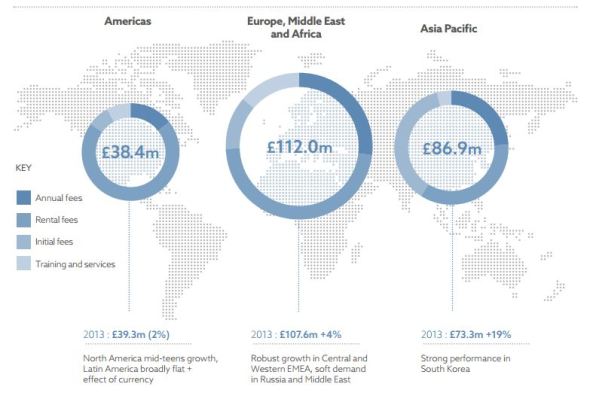
Aveva revenue in 2013, by geographic regions. (Source: Aveva)
Aveva has a strong presence in the global Oil & Gas industry; the company estimates 45%–50% of the usage of its software is in O&G. The Power sector accounts for 10%–15%, and Marine around 20%–25% of its customers’ usage of its software products.
In 2013 Asia/Pacific revenue was up 19% over 2012. South Korea’s shipbuilding industry was a big contributor to the growth. (Think of ships as floating power plants, and you see the connection to process plant design software.) In Europe/Middle East/Africa (EMEA), 2013 was affected by geopolitical issues, with lacklustre revenue growth of only 4%. The Americas are a bright spot for Aveva, one it is focusing on more these days. The US and Brazil have rapidly growing new oil development, and Mexico is modernizing.
The Russian deal
Vodokanal Engineering says it needs to offer its clients “more sophisticated” design software options. It cites KINEF LLC, which operates the largest oil refinery in North-West Russia. As part of its project management framework, KINEF encourages its contractors to invest in the most advanced technologies to create more efficient project deliverables. So Vodokanal went with Aveva, which still uses its original 3D database scheme, devised at Cambridge University in the 1970s yet comprehensive enough to remain in use today with contemporary design tools.
Vodokanal says it is not implementing PDMS just for a client, but for all its future projects. “Given KINEF’s decision to use AVEVA solutions, we were both confident and impressed enough to implement PDMS ourselves; not just for this client but across our entire project portfolio. Interoperability, flexibility and collaboration are important to our business and AVEVA technology will help us meet project challenges for years to come,” says the company in the announcement distributed by Aveva PR.